19 May 2026
Pope Leo XIV is launching a Vatican commission on artificial intelligence.
The focus is not on slowing technology down. The focus is on understanding what AI does to people.
That distinction matters more than most people will realise.
For the first time, a major global institution has publicly reframed AI as a moral and human question, not a technical or economic one. The reported concerns: human dignity, labour, justice, peace, childhood development, misuse, and the societal consequences of unconscious adoption.
You do not need to be religious to understand why this is significant.
A powerful tool still requires a moral frame. And history suggests humanity is not particularly good at building those frames while emotionally inside periods of rapid transformation.
That is the pattern I want to talk about.
We have been here before
If you strip the language back and look at history, a pattern shows up.
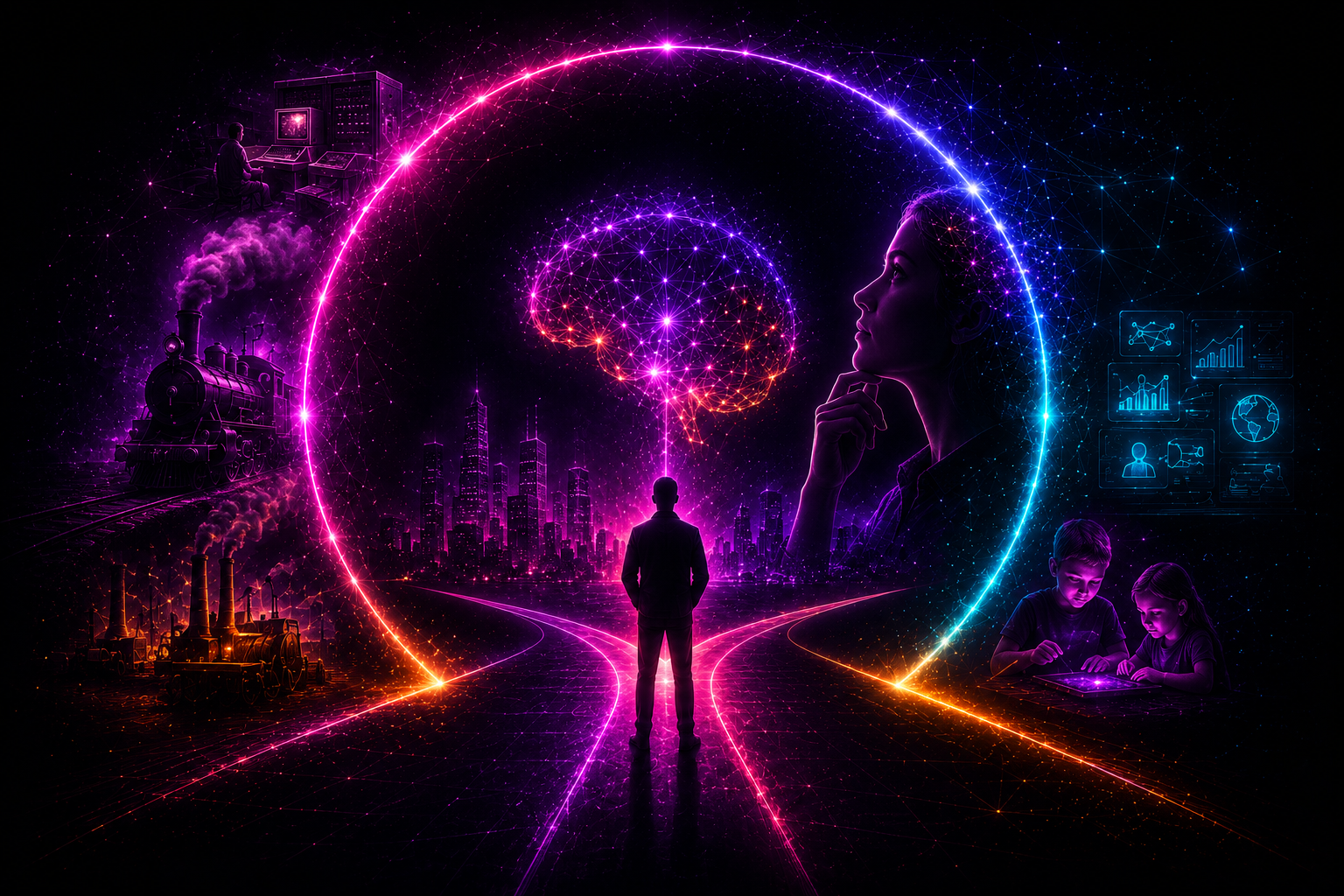
Every 80 to 90 years, we do the same thing. We accelerate. Faster than systems can stabilise. Faster than people can adapt. Faster than we can define what "better" actually looks like.
Look back.
The 1940s. Industrial acceleration. Early computing.
The 1800s. Railways. Telegraph. Real-time communication.
The 1700s. Industrial shift. New governance models.
Different technologies. Same pattern. Systems change faster than humans can keep up.
And every time, we make the same mistake. We focus on the innovation. We ignore the integration.
We ask what this can do, how fast we can scale it, who gets there first.
We do not ask what changes in real life. What needs to stay human. What success actually looks like.
Sound familiar?
That is exactly where we are right now with AI.
More tools. More output. More pressure. Less clarity.
We are not in a once-in-a-lifetime moment. We are in a recurring phase. Acceleration before integration. And this phase always feels the same. Overwhelming. Chaotic. Noisy.
The cost of skipping integration is always the same. People carry it.
Every time we accelerate this fast, we break the same thing. The human ability to keep up. And then we have to rebuild it.
This cycle does not mean everything is about to break. It means this always happens before things stabilise.
What is different this time
This cycle is not new. The pattern is not new. But there is something about this particular acceleration that is genuinely different.
AI has removed friction from production. It has not removed friction from consumption.
We can create faster. We cannot think faster.
So instead of saving time, we are shifting the load. Creation is easy. Thinking is heavier. And no one is measuring that.
Right now, most organisations are tracking time saved, output volume, and adoption rates.
What they are not tracking: error rates, rework, downstream impact, cognitive load, burnout.
Or the simplest question of all: is the outcome actually better?
There is no scope. No defined endpoint. No stabilisation point. No shared definition of success. Just constant deployment and ongoing change.
When there is no endpoint, people cannot absorb the change. They stay in a permanent state of transition.
That is not transformation. That is fatigue.
We are pushing one of the biggest shifts in how humans work and think, without addressing the human side of change.
No one is clearly explaining what this means for people's lives. What gets easier. What gets harder. What should stay human.
So people fill in the gaps themselves.
What they are hearing is "be more productive, have more freedom."
What they are feeling is more pressure, more noise, more expectation.
That is where resistance comes from. Not ignorance. Not laziness. Misalignment.
This is not a technology problem. It is a failure to define success before scaling.
And until we fix that, the pressure does not go away. It compounds.
Why this matters now
The Vatican commission matters because it is the first major institution to ask the right question.
Not "what can AI do?"
But "what does AI do to humans?"
What happens to judgment, meaning, learning, expertise, creativity, childhood, attention, social trust, and human agency when intelligence itself becomes industrialised?
The reason most of the AI conversation feels too shallow for the scale of what is actually happening is because most of the conversation is being led by people inside the acceleration, not people studying the pattern.
Too much focus on productivity, tools, automation, prompts, content, and speed.
Not enough focus on human behaviour, dependency, societal redesign, power structures, attention, dignity, judgment, or what history has already taught us about transformative systems.
This is the fundamental belief Glamabyte was built on. The future of AI is not a technology conversation. It is a human one. It is the through-line of our work and the reason the business exists.
It is also the foundation of one of my signature speaking topics. Adoption is inevitable. Being on autopilot is not. A session built specifically to walk audiences through the patterns shaping the world around them and wake them up to what is actually happening, not what they are being sold.
What this series is
This is the first piece in a long-form series.
Who Remembers: the patterns we lived through and are about to repeat.
Each piece will explore a historical moment where humanity experienced a major technological, cultural, infrastructural, political, or emotional transition. Not because history repeats perfectly, but because human patterns repeat remarkably often.
The privatisation of infrastructure. Significant cultural moments. Industrialisation. Digital and technology booms. Every one of these reshaped human behaviour more deeply than people initially understood, and every one of them was adopted faster than it was comprehended.
The series is not from hype. Not from fear. Not from "AI will save the world" or "AI will destroy it."
It is from the perspective of transformation itself, and what history has already taught us about how humans navigate, or fail to navigate, systems of this scale.
Because the real question is not how do we use AI more.
It is what are we trying to protect as we use it.
Some people are protecting profit. Some are protecting truth. Some are protecting what makes us human.
I am protecting what amplifies human brilliance.
What are you protecting?
Closing
The Vatican has opened a door to a conversation most of the AI industry has been avoiding.
I think it is time we walked through it.
Patterns repeat. Wisdom is optional.
Adoption is inevitable. Doing it on autopilot is not.
New pieces in the Who Remembers series publish every Wednesday.